Thursday, 15 July 2010

Raw Milk


FoodLovers Market

Rupert Street/Winnett Street
Soho
London

*Guest post by Marina*

I've been wanting to try raw milk ever since reading about the controversy over it in the US. Luckily, A and I went to check out a new food market in Soho and there was a stand from Hook & Son serving up half pints of raw milk to try for a quid. I seized the opportunity and received a plastic cup of milk that was much whiter and opaque than the milk I get from the supermarket. To be fair, I usually drink skim milk, which is quite watery when compared to full fat milk, but not only did the raw milk taste creamier, it was also tasted milkier, if that makes any sense. They also had raw milk cream and butter at the stand - I might have to try making my own butter out of their cream some time - I bet it would taste incredible. If you like milk, you should try this stuff - it's concentrated milk goodness.

Wednesday, 14 July 2010

Burrow Hill Cider


Pass Vale Farm
Burrow Hill
Kingsbury Episcopi 
Somerset TA12 6BU

Burrow Farm Pressed Somerset Cider is the real deal, which is why it's sold in what look like petrol canisters, straight from the barrel. We picked up this blend of "at least" 11 varieties of vintage cider apples from the farm itself, on a trip to the Westcountry. As we were browsing in the farm shop two cars pulled up, separately, their owners walking in with multiple empties demanding refills "for the weekend".

As for the contents, this 6% cider (we went for the medium one) was slightly cloudy, as you'd expect from proper ciders, with a golden hue. The aroma was fresh apple and farmyard spice and it tasted of ripe apples, with the faintest spritz; dry, but balanced.
The farm, in a place called Kinsbury Episcopi
, is also responsible for producing an interesting range of cider brandies (on which more soon), as well as The Somerset Pomona, a delicious blend of cider brandy and apple juice. They is good apples.

Monday, 12 July 2010

WS#4: Islay


Islay whisky is filthy (in the peated sense, you understand). It's hard to believe a pile of mud and yellow-brown water can produce such a fine tasting spirit, but believe it you must (although malted barley is also said to play a part). For Whisky Squad #4, we decided to focus entirely on Islay, whose eight active distilleries made producing a playlist of four a challenge in itself. Eventually, led by Darren the whisky guy, malt's answer to Professor Dumbledore, we fell upon the following spell-binding spirits...

Bunnahabhain 18

43% ABV
Nose: Honey, sherry, cheap chocolate brownies.
Taste: Vanilla fudge, milk chocolate, rich. Not peaty.

Bruichladdich Peat
46% ABV
Nose: Tequila, cheese, unwashed running socks, green sap
Taste: Parma Violets, vanilla, not very peaty (again).

Caol Ila Unpeated 10
65.8% ABV (cask strength)
Colour: Light straw
Nose: Nasally powerful. Fudge.
Taste: Orange zest, honey and coal sacks.

Lagavulin Distillery Only
51.5% ABV. Only 6,000 bottles produced. No age statement. 
This was essentially the classic Distillers Edition (almost 16 years in bourbon before being finished in Pedro Ximenez sherry casks), further matured in a PX sherry-soaked bourbon cask for an additional three to six months and bottled at cask strength.
Nose: White chocolate and smoke, with dates.
Taste: Vanilla-sweet and richly peaty with a long, sweet finish. Like Christmas Day.

The Lagavulin, procured on a trip to Islay, was a great after-dinner dram, the most popular with the Squad, and finally some peat! Overall, our quartet was distinctly less peatsome than your average Islay session, but for a sweltering hot Thursday evening it may have been just what the whisky doctor ordered.

For a bonus round, courtesy of brilliant booze blogger Billy, we enjoyed a miniature sample of 
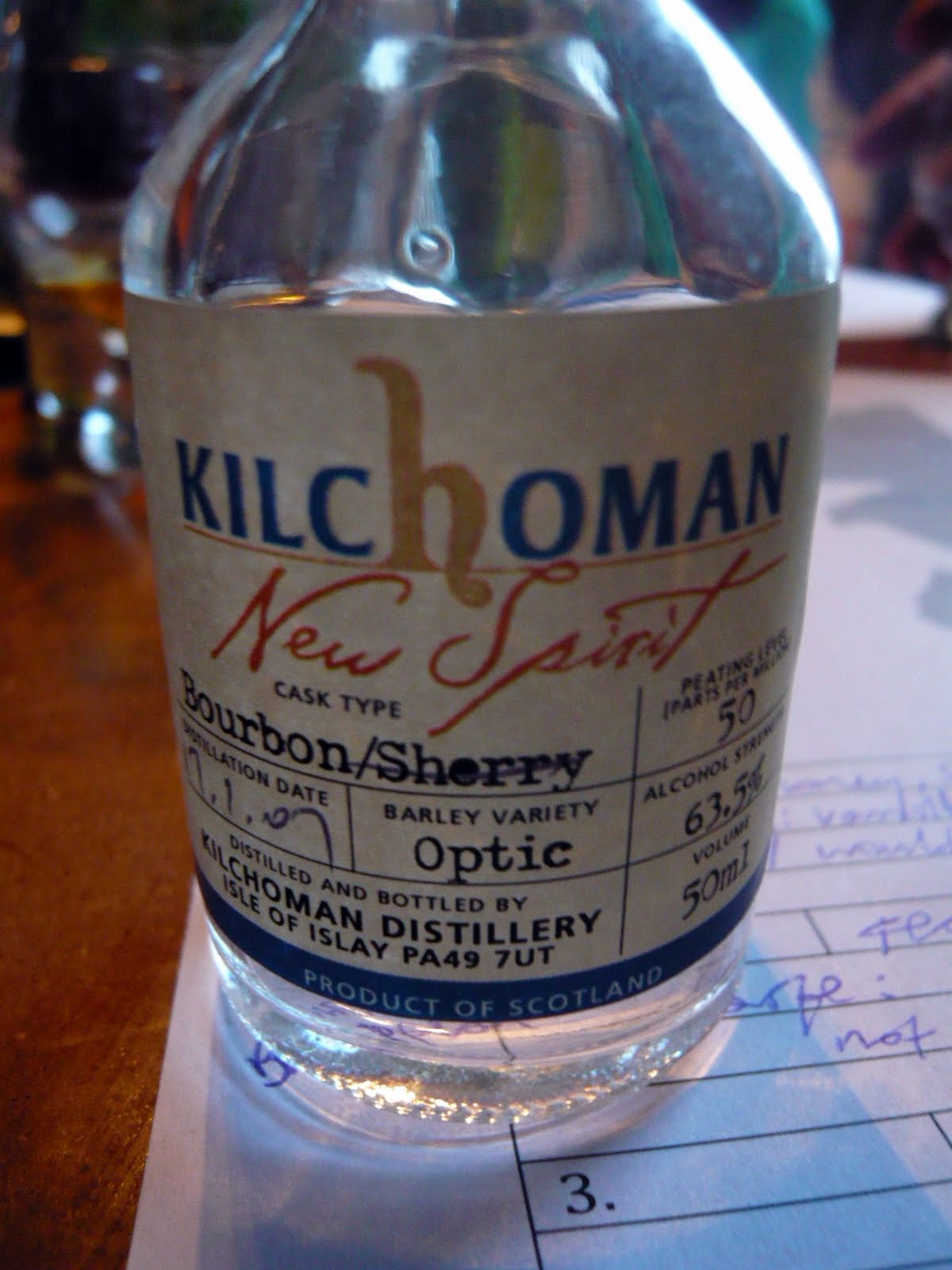
Kilchoman "new spirit plus about six months in the barrel", from the island's newest distillery (circa 2005). It gave us aromas of virginal malted barley with a hint of peat, and a palate of peat vodka. Underdeveloped, but moving in the right direction.

Thanks to the Whisky Squaddies for help with the tasting notes, as always.
Next month, we're on summer whiskies, so let's hope the weather stays appropriately uncold.

RIVAL BLOG CORNER:
Read Billy's nasally challenged but peerless account here and Darren's part-finished but learned effort right here.

Sunday, 11 July 2010

Dalmore Mackenzie


The Dalmore Mackenzie was released earlier this year - just 3,000 bottles of the stuff - in part to raise funds to refurbish a castle owned by the distillery's former owners (the Mackenzies). With such important history involved it seemed apt to try this sample bottle, from the company's PR team, in Scotland. And so, in a room in the Holiday Inn next to Glasgow Airport, waiting for our flight to Islay, we cracked it open.

Notes

Colour: Reddish
Nose: Rich Xmas cake, marzipan, Fisherman's Friend, sweetness
Taste: Toffee, orange peel explosion, tangerine peel, with a second wave leaving pepper on the tongue. Dry finish.

The spirit was distilled in 1992, held in American oak casks for 11 years, then finished in fresh port pipes, before being bottled at 46%. The red tinge from the port is said to link the whisky to the blood of the injured stag, Dalmore's logo. And? We thought it a terrific whisky, and a perfect aperitif to a peaty weekend in Islay. But we wouldn't have paid the £100 asking price.

Thursday, 8 July 2010

Jägerbomb


The Jägerbomb is Jägermeister and Red Bull. If you look carefully at the picture above you can see a smaller shot glass sitting inside a larger tumbler. That's the J-bomb primed to go off.

How To:


Fill a shot glass with Jägermeister and half-fill a tumbler with Red Bull.
Drop the shot glass into the tumbler and sink the lot.

It's actually not as bad as it sounds, and it made a change from the usual sambuca or mixto tequila shots. I want to write more about 
Jägermeister, a 35% abv digestif made with herbs and spices, but I'll leave that for another post, since its 'complex flavours' are probably wasted here.

Tuesday, 6 July 2010

Ardbeg


*Guest post by Tim*

It is rare to find 'the one' meant for you. Someone who stands out from the crowd, has a bit of an attitude, plenty of personality and who is exciting to be around. So when you do find her, you should cherish her, treat her properly and remain faithful.

I thought I had that with Ardbeg Ten, the punchy little malt from the Inner Hebrides. She offers a brilliant mix of a toffee, creamy and salty nose with plenty of iodine. The taste is sweet before a rush of peat hits your tongue followed by a waft of tobacco smoke which lingers on the palate. The problem is that curiosity so often gets the better of us. Bluntly, if she is tasty, then what are her sisters like?

A visit to Ardbeg’s home on the island of Islay, and a distillery tour (left), provided just the opportunity for a little, um, experimentation. But then came a classic male mistake. The tour guide laid out all the malts and I went for the one with the promise of immediate gratification. The latest expression of Ardbeg Supernova boasts phenolic levels of 100 ppm, around twice the level of the Ardbeg Ten. This is irresistible to any lover of peaty malts. The nose was surprisingly underwhelming. In the mouth the smoky peat was there and a little pepper too. But there was little more. At £80 a bottle, she’s an expensive date but doesn’t offer up as much as you might hope.

Then came the real treat: Ardbeg Uigeadailnamed after the loch that provides the distillery’s water. It includes some spirit aged in sherry butts as well as bourbon casks. The nose was Christmas cake and wood smoke. The flavours in the mouth were rich and luscious but all of the fantastic peaty flavours were still there. The tastes lingered long after the liquid was gone.
So it was time to look at one of the younger sisters. We were offered up Still Young, a perky little nine-year old and part of a series charting the development of the classic Ardbeg Ten. The toffee, the salt, the peat were all there. At 56.2% ABV she should have packed a few more flavours, but in the end there was little to make her stand out from her 10 year-old sibling.

By comparison, Ardbeg Corryvreckan, which included spirit aged in French oak casks, lacked a certain pizazz. She gave little away on the nose aside from a hint of cut grass. In the mouth the whisky tasted summery and somewhat dry with a white wine feel. Perhaps trying the Corryvreckan after the Uigeadail is akin to sipping gaspacho after chocolate pudding. She just wasn’t right for the mood. Likewise Rollercoaster, a bit of a gimmick of a whisky incorporating ten casks, one from each year from 1997. She was pleasant but tasted thinner than the ten-year and, in the end, was nothing special.

So after these dalliances, did I return back to Ardbeg Ten, a little shamefaced but with renewed loyalty? Yes and no. Ardbeg is still at the front of my drinks cupboard but sitting next to her in filial harmony is a bottle of Ardbeg Uigeadail for those occasions when only something a little spicier will do.

Sunday, 4 July 2010

Islay


A trip to
Islay, for a whisky lover, is a pilgrimage of religious proportions. My four-day trip, with drinking buddies T and J, took in seven of the eight distilleries on the island - and many more whiskies besides.

We started off, almost by accident, at Laphroig (above), while waiting for an appointment at Lagavulin. A 'quick peek' turned into a distillery tour, and a dram, and we got to see the floor maltings (right), where the barley grains are laid out to germinate in the early stage of the production process. The other distilleries in Islay - with the exception of newbie Kilchoman - all use Diageo's maltings facility, and even Laphroig only produces about 15% of its malt on site. But it gave us a good sense of how it used to be done in the olden days. As for the dram, I believe it was their Quarter Cask, which I preferred to the slightly rougher, and medicinally pungent, 10-year-old standard.

Then on to Lagavulin, where we went on another tour and I began to appreciate the process: soak the barley, turn it, dry it over a peat fire, grind it, ferment it with yeast and water, distill the mixture twice (in pot stills, pictured left), mature it, drink it. Here we were fortunate enough to sample some terrific whiskies, as follows:

Lagavulin Distillery Only
Only 6,000 bottles produced. No age statement. 51.5% ABV.
This was essentially the classic Distillers Edition (almost 16 years in bourbon before being finished in Pedro Ximenez sherry casks), further matured in a PX sherry-soaked bourbon cask for an additional three to six months and bottled at cask strength.
Note: White chocolate and smoke on the nose. Vanilla-sweet and rich on the palate with a long, sweet finish. A great after-dinner dram.

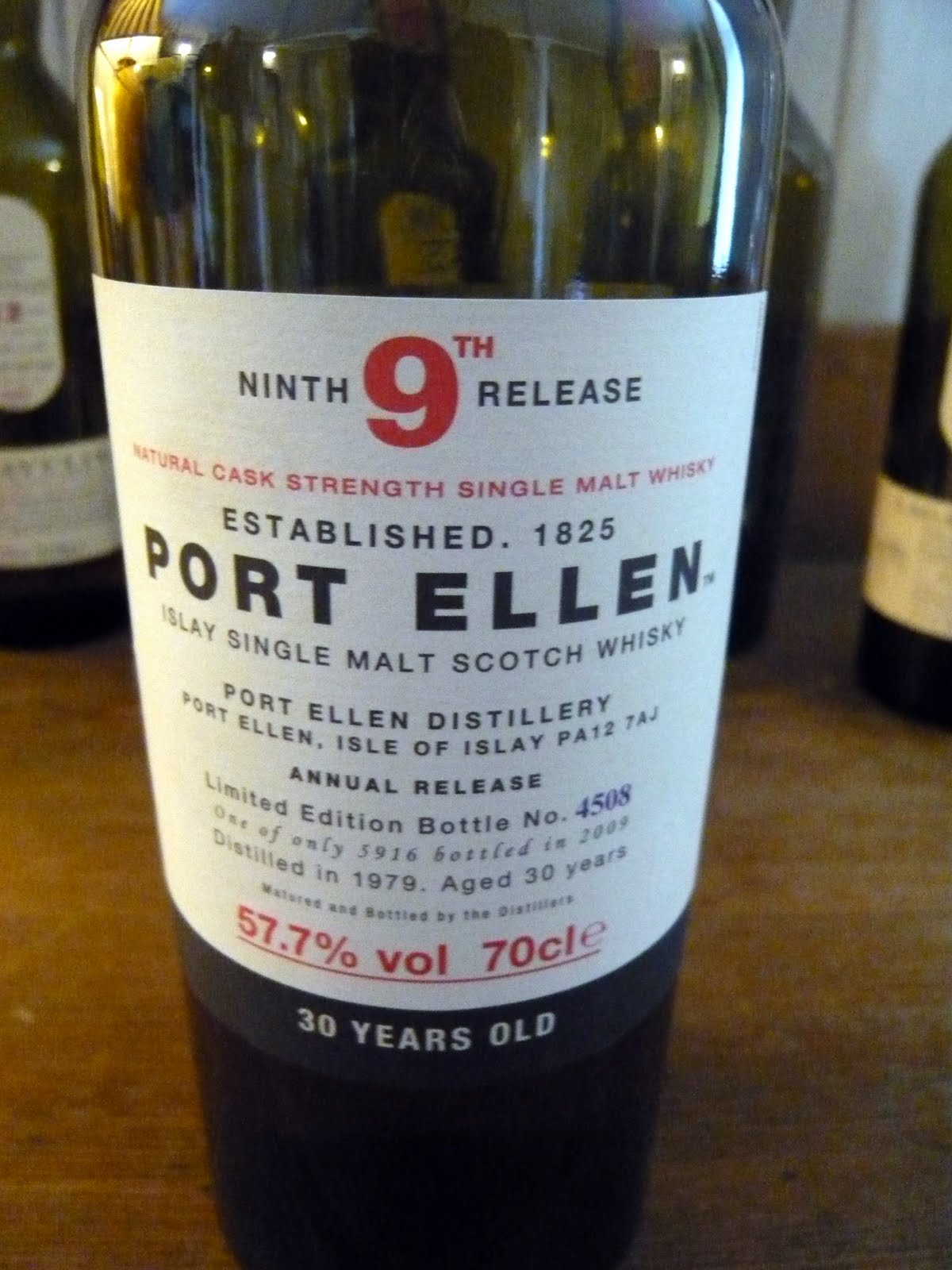
Port Ellen 30-year-old

The distillery ceased production in 1983, and Lagavulin are looking after the remaining stock, and looking after it well by the evidence of this whisky (right).
Note: Slightly minty aroma, with pepper. On the palate, tangy lemon, like sherbert; slightly medicinal with a sweet nuttiness at the end.

From Lagavulin, we caught a cab (public transport not being what it might be) to Bruichladdich, the island's renegade independent distillery. An enjoyable tour finished with a generous tasting session, where I tried a few of the 30-odd expressions, a rather bewildering array of options that left me intrigued but not buying.

Sunday was Ardbeg day, and a chance to try a few of theirs too, including my favourite, the sherry-finished Uigeadail, a bottle of fruity, sweetish peat so beguiling I had to take one home with me. (Full Ardbeg write-up to follow).

Then, on Monday, we visited Caol Ila, which I confess I knew little about before our visit. A further tour was rewarded with one of the tastiest drams of the trip, a Caol Ila 25-year-old (left), which I recall hazily as offering creamy caramel fudge side-by-side with gentle peat.

Caol Ila enjoys the most beautiful setting of all the island's distilleries, looking out across the sea and beyond to the island of Jura (below right). They need to set up a cafe down there. Or a bar, at least.

Then to Bunnahabhain, whose wares are the least peaty of the Islay malts. Not that this was a problem, having had just about my fill of peaty potions and phenolic tonics: Bunnahab's fudgy 18-year-old was just the dessert drink I'd been craving for.

Finally, and just as our taste buds were giving way, we popped into Bowmore, whose visitor centre was the most obviously impressive. As we shared a couple of drams on the balcony, overlooking the sea, we felt decidedly well whiskied.

Kilchoman was the only distillery we failed to visit. Established in 2005, it's also the newest - and the first to be built on Islay for 124 years. Being so young, its only product so far is a three-year-old, which we sampled at a pub one evening and found to be showing much promise.

The biggest surprise of the trip was the state of the water used to make the whisky. For some reason, having read distilleries' tributes to their magical lochs and springs, I'd always imagined the liquid itself would look cleanish, if not crystal clear. Then I was shown a mug of the stuff (left - that's Ardbeg's finest, from Loch Uigeadail, yellow-brown from the peat). Still, as Woody Allen says, whatever works.